
















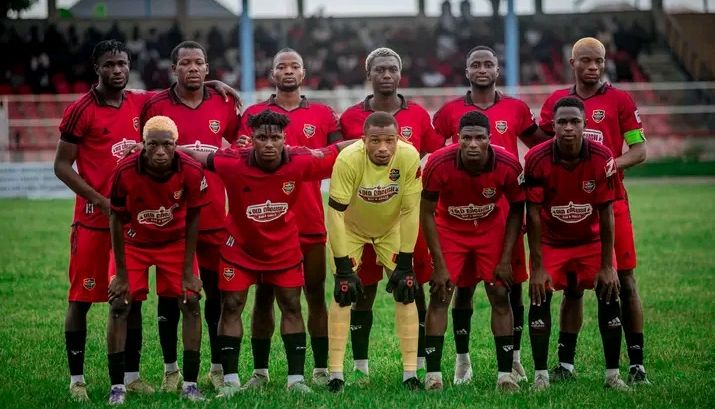
By Emmanuel Mbah
The final whistle against Wikki Tourists in Owerri felt less like celebration and more like release, Puyaka.net reports
Rain had battered the city long before kickoff. Floodlights eventually illuminated a match that began later than every other decisive fixture across the Nigeria Premier Football League. The tension was suffocating. Kun Khalifat were staring at the possibility of relegation. Wikki Tourists, already condemned to the drop, had nothing left to lose.
Then came the early shock.
Wikki scored first, silencing a stadium already weighed down by months of anxiety. For a few moments, it looked as though the entire season, all the controversy, all the instability, all the emotional exhaustion, was about to collapse into disaster.
But Kun Khalifat responded.
They fought back to win 3-1 under the floodlights, turning panic into survival. Players collapsed onto the wet turf at full time. Supporters roared with the relief of people who had spent an entire season living on the edge.
And perhaps that image, more than any other, captured the true story of Kun Khalifat’s campaign: a club constantly staring into chaos yet somehow refusing to disappear.
This was not a normal football season.
Kun Khalifat spent most of the campaign balancing between survival and self-destruction. On the pitch, they battled relegation almost every week. Off the pitch, they wrestled with managerial instability, internal uncertainty, controversial decisions and one of the most dramatic administrative episodes Nigerian football has witnessed in recent years.
The club’s temporary withdrawal from the NPFL changed the tone of their season completely.
What initially appeared impossible became reality when Kun Khalifat pulled out of the league amid grievances surrounding officiating, treatment within the system and growing frustrations behind the scenes. The decision triggered outrage across Nigerian football. Critics described it as reckless and damaging to the integrity of the competition. Others argued it exposed frustrations many clubs quietly endure but rarely confront publicly.
Either way, the move left scars.
Their eventual return to the league was inevitable, but confidence around the club suffered heavily. Rival fans mocked the leadership. Questions emerged about emotional decision-making at executive level. The dressing room itself appeared caught in the turbulence.
From that point onward, every fixture felt like damage control.
The deeper problem was that instability had already become part of the club’s identity.
Kun Khalifat began the season carrying ambition. There was genuine belief that the club could establish itself as a serious long-term NPFL project. Recruitment suggested intent. Public messaging carried confidence. Supporters hoped they were watching the foundation of something sustainable.
Instead, the campaign became defined by uncertainty.
Managerial changes disrupted whatever rhythm the team attempted to build. Tactical identities shifted repeatedly. One coach demanded front-foot aggression. Another preferred caution and defensive structure. Players often looked trapped between conflicting instructions, unable to settle into a consistent style.
Frequent coaching changes are often presented in Nigerian football as signs of ambition. In reality, they are usually symptoms of deeper disorder.
Kun Khalifat became another reminder of that truth.
The relegation battle exposed weaknesses that had been hidden earlier in the season. Squad depth looked thin during critical moments. Recruitment decisions came under scrutiny. Game management repeatedly failed the team in matches they should have controlled.
Too often, Kun Khalifat looked reactive instead of prepared.
Yet this season cannot be told only through failure and controversy because there were moments when the club revealed genuine character.
Supporters remained remarkably loyal despite the noise surrounding the team. Even during difficult away trips and tense home fixtures, belief never fully disappeared. The atmosphere around some of their survival matches reflected a fanbase desperate to protect its place in top-flight football.
Several players also emerged stronger from the chaos.
Young footballers thrown into pressure situations matured quickly. Senior figures accepted responsibility when it would have been easier to disappear into excuses. There were matches where Kun Khalifat played with urgency, courage and emotional resilience that deserved admiration.
That resilience became even more meaningful in light of the tragedies surrounding the club.
The deaths of former captain and team manager Chijioke Ekpemandu cast a shadow over the season. Beyond football, it was a painful reminder of the human side of the game, the emotional bonds that exist inside clubs beyond results and league tables. His absence was deeply felt around the team throughout the campaign.
In many ways, Kun Khalifat spent this season carrying grief alongside pressure.
Still, sympathy alone cannot erase the club’s mistakes.
There will be those who argue that Kun Khalifat were victims of circumstances: poor officiating, structural problems within Nigerian football, inconsistent administration across the league and the financial strain that many clubs quietly endure.
Some of those arguments are valid.
The NPFL remains a difficult environment in which to build stability. Governance controversies are not unique to Kun Khalifat. Many clubs have privately shared frustrations similar to those expressed publicly during the withdrawal saga.
But acknowledging those realities cannot excuse avoidable self-inflicted instability.
No serious football institution can repeatedly operate through emotion and expect long-term progress. Public confrontations, abrupt decisions and constant disruption eventually weaken the very project they are supposed to protect.
The strongest clubs in Nigerian football are rarely the most dramatic. They are usually the most organised.
That is the crossroads now facing Kun Khalifat.
Survival should not become a distraction from reflection. Escaping relegation on a rain-soaked night in Owerri may feel heroic today, but football has a short memory. If the same structural problems remain unresolved, another crisis will arrive soon enough.
The club must decide what it truly wants to become.
If Kun Khalifat genuinely aspire to establish themselves among the NPFL’s respected institutions, then stability must replace reaction. Executive clarity must replace confusion. Coaching appointments must be guided by long-term football philosophy instead of short-term panic.
Most importantly, the club must stop fighting itself.
Because beneath all the turbulence lies something worth preserving.
There is passion around Kun Khalifat. There is emotional investment from supporters. There are players capable of growth. There is still enough goodwill for reinvention.
But survival alone cannot be the ambition forever.
This season should serve as a warning, not a template.
Kun Khalifat escaped the fire. The challenge now is ensuring they never willingly walk back into it.




Add Comment